cramp
The cramp, which Santiago calls a calambre, is a sudden, painful contraction of his left hand that strikes him hours into his battle with the marlin, transforming his own body into an adversary. It is not a mere inconvenience but a treachery of the flesh, a humiliating failure of the physical self that the old man must overcome through sheer force of will. The cramp becomes a central test of Santiago's endurance, a concrete, agonizing obstacle that he must manage alongside the immense fish, and it deepens the novel's exploration of the relationship between a man's spirit and his aging, vulnerable body.
Onset and Immediate Consequences
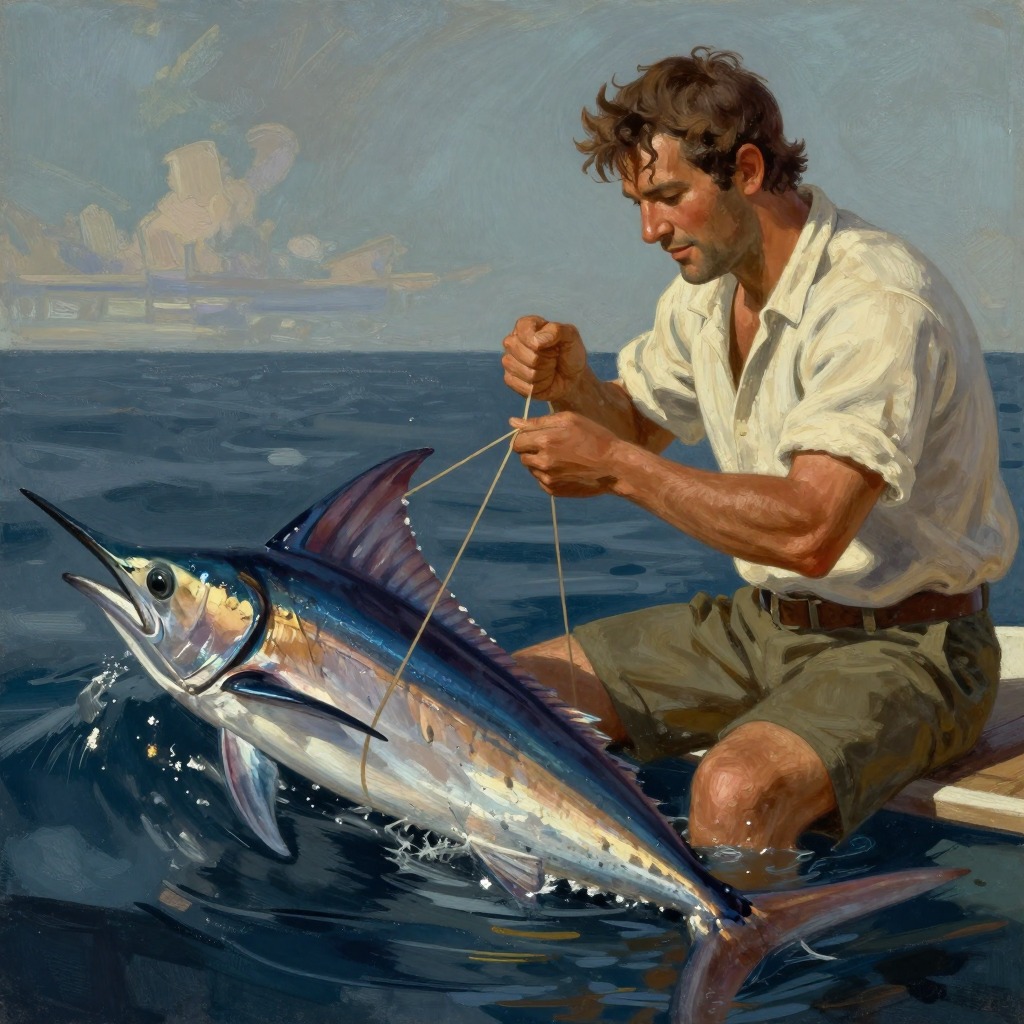
The cramp first seizes Santiago's left hand after he has been holding the line for many hours, following the hooking of the marlin. As he cuts strips of raw bonito to eat, he feels the steady, hard pull of the line and his left hand draws up tight on the heavy cord, becoming almost as stiff as rigor mortis. He looks at it in disgust, addressing it directly: "What kind of a hand is that," he says, "Cramp then if you want. Make yourself into a claw. It will do you no good." The cramp renders his left hand useless, forcing him to rely entirely on his right arm and his back, and it adds a new layer of suffering to his already excruciating ordeal. He is forced to eat the raw tuna, chewing it carefully, hoping the nourishment will restore the hand, and he rubs it against his trousers, trying to gentle the fingers, but it will not open.
The Cramp as a Betrayal and a Test
Santiago's reaction to the cramp reveals his deep sense of personal responsibility and his view of the body as a partner that must not fail. He thinks of it as "a treachery of one's own body," a humiliation that is worse when one is alone, because there is no one to witness or alleviate it. He contrasts it with other bodily failures, noting that a cramp "humiliates oneself especially when one is alone." The cramp is not just a physical pain; it is a moral failing, a weakness that he must conquer. He wishes the boy were there to rub it and loosen it down from the forearm, but he is alone, and he must rely on his own resources. He commands his hand to uncramp, and he forces himself to eat more of the raw fish, telling the hand, "I do this for you." The cramp thus becomes a test of his will, a challenge to his identity as a fisherman who can endure anything.
Resolution and Thematic Significance
The cramp eventually subsides, but only after a long and painful struggle. After the marlin jumps for the first time, Santiago's left hand remains tight as the gripped claws of an eagle, but he believes it will uncramp, thinking of the fish and his two hands as three things that are brothers. It is not until noon of the second day, after the sun has risen and the wind has come up from the east, that his left hand finally uncramps. He announces this to the fish as "Bad news for you, fish." The resolution of the cramp is a small victory, a sign that his body is still capable of obeying his will. However, the cramp returns later in the night, when the fish makes a sudden, desperate run, and Santiago's left hand again fails him, cutting badly as it takes the strain. He scolds it, saying, "You did not do so badly for something worthless," but he also acknowledges that he was not born with two good hands, and that perhaps it was his fault for not training it properly. The cramp, therefore, is not a single event but a recurring motif that underscores the fragility of the human body and the relentless nature of the old man's struggle. It is a physical manifestation of the novel's central theme: that a man can be destroyed but not defeated, and that the true battle is not against the fish or the sharks, but against the limitations of one's own flesh.